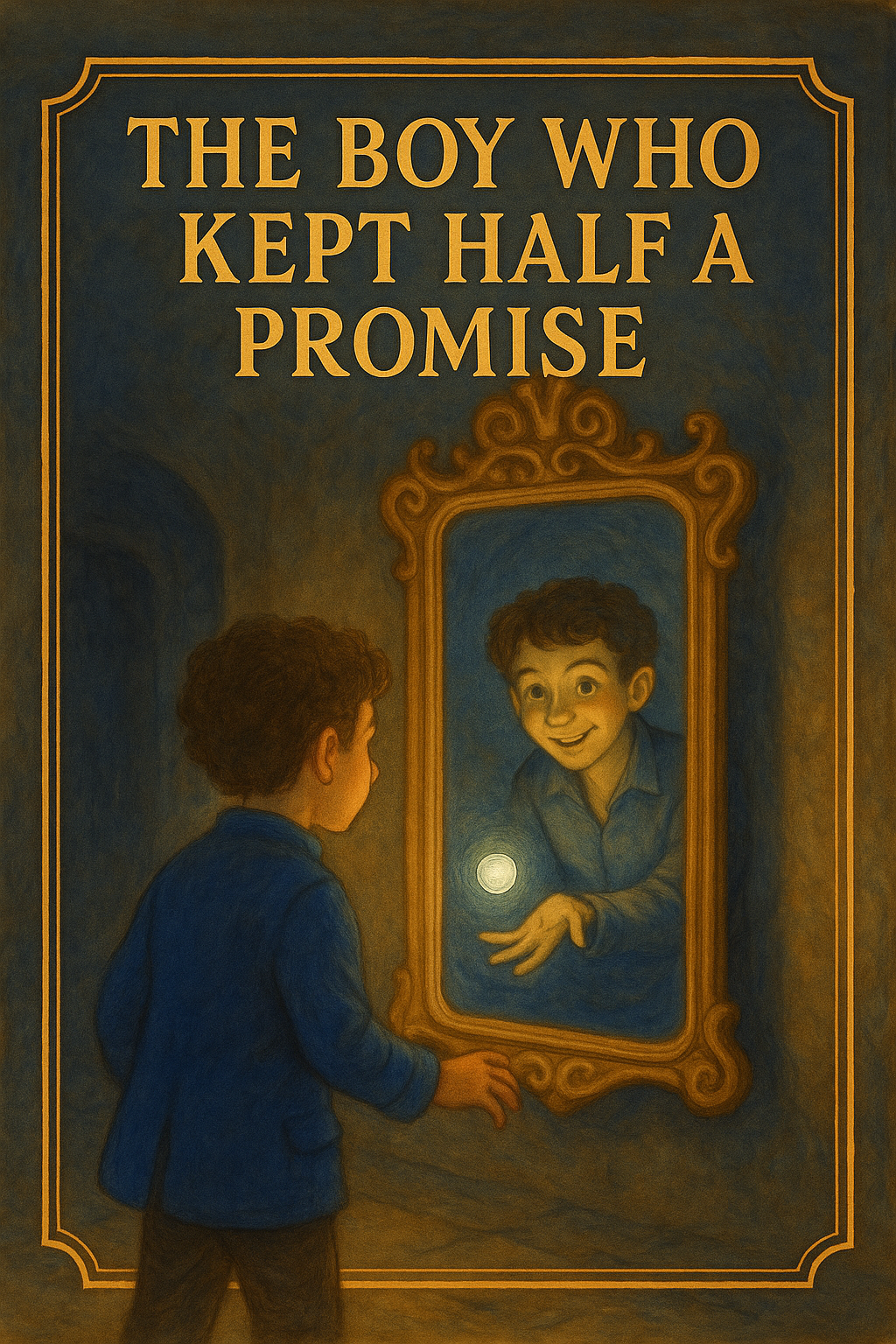
There was once a boy named Lucio who lived in the middle of the city—not so high as the silk-hatted rich, not so low as the rope-scarred sailors, but right where the market smelled of warm bread and the lamplighters knew every doorstep by name.
Lucio was a good boy in most ways, but he had one habit that put worry-lines in his mother's face.
When Lucio made promises, he kept them partway.
If he promised to sweep the whole floor, he swept most of it and left the corners. If he promised to come home before the evening bells, he came home just after and swore the bells had rung early. If he promised to tell the truth, he told enough to sound honest and kept the sharp bits tucked away.
His mother warned him again and again.
"In Venturia," she said, "words have weight. A promise made is a debt agreed."
But Lucio only shrugged. What harm could there be in a promise kept almost?
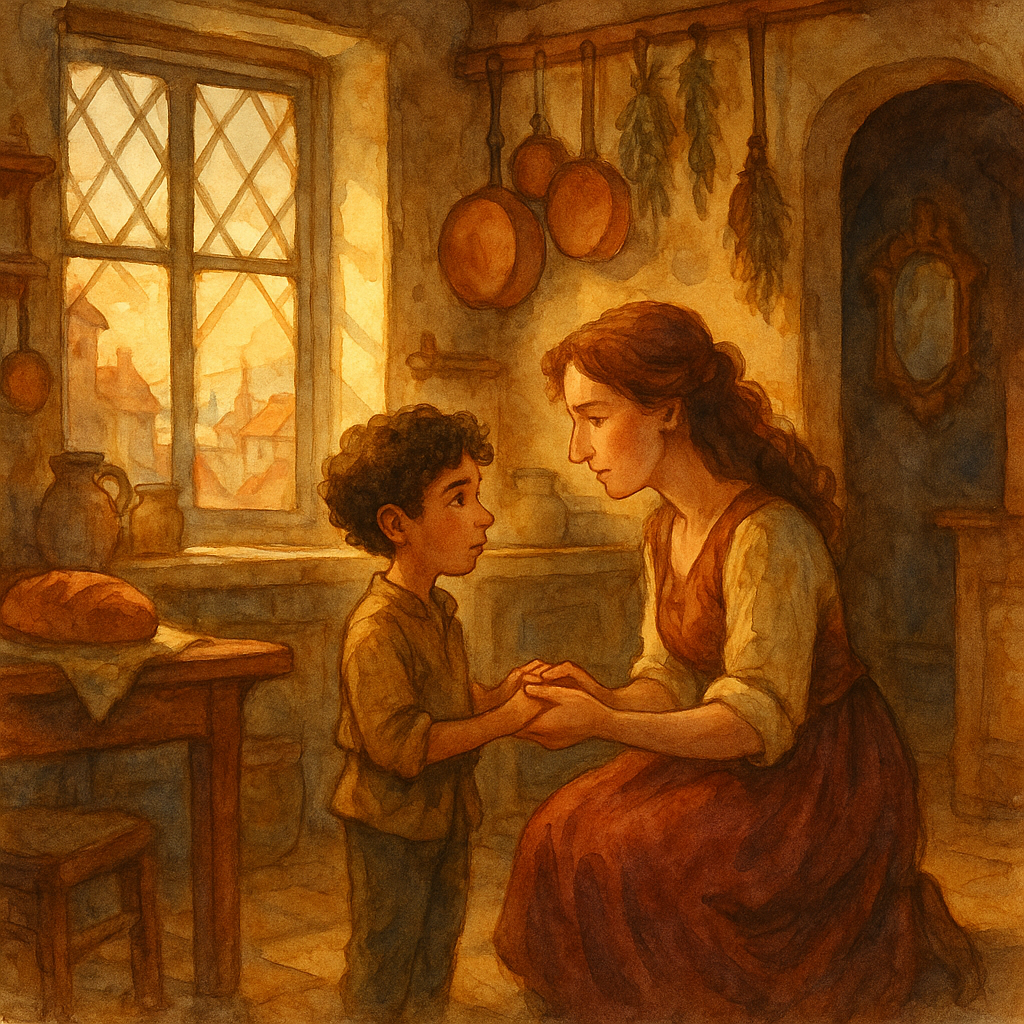
One autumn day, Lucio's grandmother fell ill in the upper city, and his mother needed to bring her food and medicine. The climb was steep and long, so she left Lucio at home and made him promise three things, slow and solemn, as if she were laying stones in a wall.
"First: do not leave the house until I return.
Second: do not open the door to any stranger.
Third: do not look into the hallway mirror after dark."
Lucio promised all three. His mother kissed his forehead and went.
For a while, he did wonderfully. He played. He ate his bread. When a woman knocked asking for water, he did not open the door. When a man called through the keyhole claiming he had a message, Lucio stayed quiet as a mouse.
Two whole promises kept clean. He felt proud enough to burst.
But as the day thinned and the light turned honey-gold, then copper, then dim gray, boredom crept in. And with it came curiosity—curiosity with soft feet and sharp teeth.
Why the mirror?
Lucio had looked into it every morning while his mother braided his hair. It was only glass in a wooden frame. Nothing special. Nothing dangerous.
The evening bells rang. Lucio watched the last strip of daylight slip between the shutters, and he told himself a very careful lie:
It isn't fully dark yet. Not really. If I look now, it doesn't count.
So he went to the hallway mirror and looked.
At first, he saw only himself—a boy in a dim corridor, eyes wide in fading light.
Then the reflection tilted its head when Lucio did not.
Then it smiled when Lucio wasn't smiling at all.
"Hello," said the reflection.
Its voice was Lucio's voice, but it came from the wrong place, like a whisper from the bottom of a well.
Lucio's heart banged in his ribs. He should have run. But half-kept promises make half-brave children: brave enough to linger, not brave enough to flee.
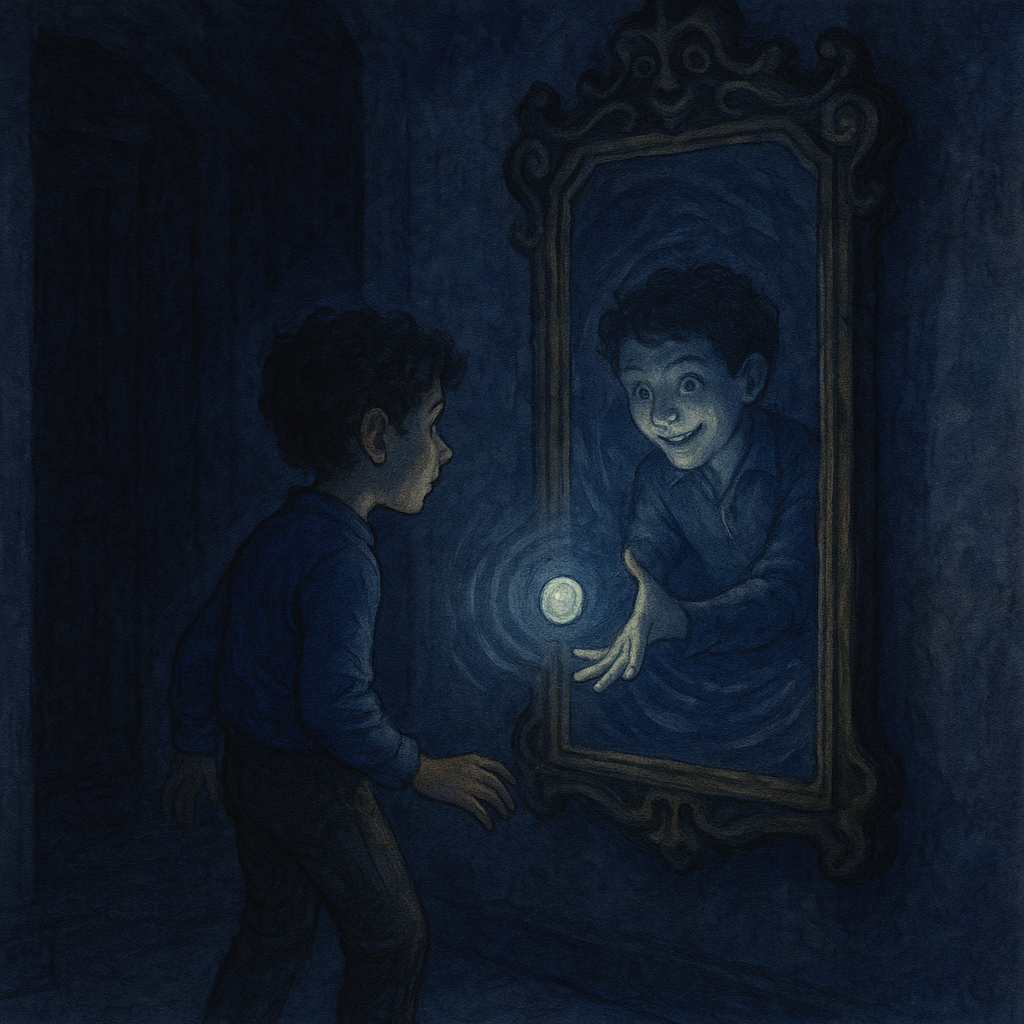
"I have been waiting," said the reflection. "For someone who leaves rules open a crack. Someone who stands with one foot on each side of a line."
It pressed its palm to the glass.
The mirror rippled, not like solid glass, but like the skin of a puddle. Fingers pushed through, cold and pale, and in the reflection's hand lay a coin that gleamed like moonlight.
"Take it," said the reflection. "It will grant you one wish. But you must promise me something in return."
Lucio swallowed.
"You must return on the first night of the Masquerade," the reflection said, "and bring me something of equal value. Not near the first night. Not after. The first."
Lucio knew he should refuse. He knew his mother's warnings were not theatre. But the coin shone, and his want rose up like a tide.
And Lucio thought—as he always thought—that a promise could be stretched without snapping.
"I promise," he said, and took the coin.
The reflection's smile widened, satisfied. It slid back into the mirror, and the glass stilled as if it had never moved at all.
That night, Lucio wished for a fine coat like the rich children wore—deep cloth, bright stitching, buttons that caught the lamplight like little stars.
In the morning, it hung over his chair.
He wore it proudly. He hid the coin. When his mother asked where the coat came from, he told her he'd found it in the street. He told most of the truth, as he always did.
The weeks passed. Autumn deepened. The Masquerade drew close. And Lucio did what he was best at doing:
He let the promise become blurry.
On the first night of the Masquerade, he went to the festival with his friends. He wore the coat. He ate sugared cakes. He laughed at the mummers and watched the lanterns sway like captive stars.
He did not return to the mirror.
He told himself, Tomorrow. Then, Soon. Then, It was probably nothing.

Late that night, Lucio came home humming, a little drunk on music and bright lights. He walked past the hallway mirror without looking at it.
He was nearly at his room when he heard his own voice behind him.
"You promised."
Lucio turned.
His reflection stood in the hallway—still as a person, solid as a stranger—though Lucio had already stepped past the mirror.
And it wore his fine coat.
The reflection smiled. It was Lucio's smile, copied poorly.
"You promised to come back," it said. "You promised to bring something of equal value. Instead, you came home empty."
"I forgot," Lucio whispered. "I'll bring something tomorrow."
The reflection's eyes flicked over him like a clerk counting coins.
"That is what you always do," it said softly. "You keep a promise… partway."
Then it held up the moonlit coin—though Lucio had hidden it.
"I gave you one wish," the reflection said. "So now, I will take what you offered me."
It stepped closer.
The air grew cold, as if the hallway had opened a door into winter. The reflection reached toward Lucio's chest. Its fingers passed through him the way they had passed through the mirror.
Lucio gasped—not from pain, but from a sudden terrible emptiness, like realizing mid-step that the stair you expected isn't there.
The reflection drew its hand back.
In its palm was something that was not blood and not flesh, but looked like a sliver of lamplight caught in ice: half of Lucio's shadow, wriggling like it wanted to rejoin the floor.
"You promised equal value," the reflection said. "You brought nothing. So I will take what you did not think to offer."
It tucked the shadow into its coat like a handkerchief.
Lucio looked down.
His coat was whole. His body was whole. Yet he felt… less. Like a story missing its ending.
He staggered to the mirror and looked.
In the glass, the reflection wore the coat—but only half of it, one side rich and fine, the other side plain as if the wish had run out midway.
And Lucio saw something worse: the reflection's shadow on the mirror-floor was complete, while his own feet cast only a thin, broken smear.
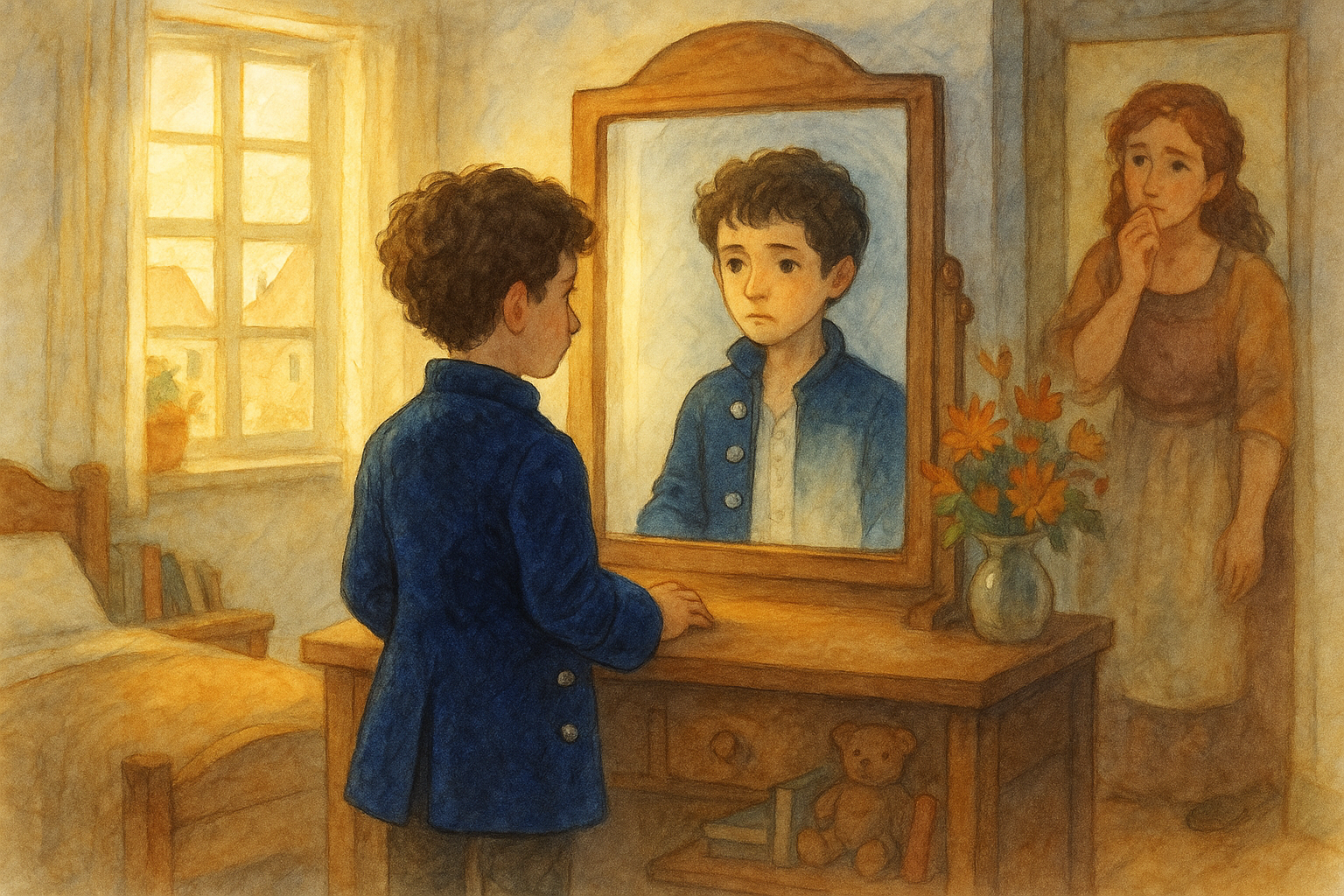
From that day onward, the city saw what Lucio had done.
In every mirror, his reflection was incomplete. In every lamplight, his shadow was wrong—faint on one side, missing on the other. Dogs barked at him. Small children stared. People who bargained for a living learned to avoid him, as if his presence made agreements slippery.
It wasn't that he looked half a boy.
It was that everyone could tell, without being told, that Lucio was someone whose words didn't quite land.
His mother saw it the next morning and wept as if she'd lost him.
"I warned you," she said. "In Venturia, words have weight."
Lucio grew older. And he did become an honest man. He kept his promises fully, every time, until his tongue was as trustworthy as a locked door.
But the city never forgot what he had been, because his reflection never let it.
Even when he spoke true, even when he did right, there was always that missing half—always the proof that once, he had tried to pay only part of what he owed.
They say the mirror still hangs somewhere in a house in the middle of Venturia. They say if you look into it after dark, you might see a boy who looks almost like you, smiling in a way you are not smiling—
waiting for someone who thinks almost is the same as kept.
So when you make a promise, little one, keep it whole.
Because in Venturia, words have weight.
And what you don't finish… finishes you.
A promise isn't "mostly kept." It's kept—or it becomes a debt someone else collects.